
The Kelso Rooster: Walter Kelso's Bloodline & Why It's the Cutter's Choice
Why Kelso Matters
Among the four foundation lines that dominate Filipino sabong, the Kelso is the cutter. Sweater wins by sustained pressure. Hatch wins by per-strike power. Roundhead wins by aerial timing. Kelso wins by precision — by managing distance until it can release one or two clean angled gaff cuts that end the fight. In knife formats where one decisive strike decides the match, that precision is the most efficient way to win, and that efficiency is why Walter Kelso's name is spoken in Filipino galleras almost as often as Carol Nesmith's.
The cocker's craft of Kelso is patience. A well-bred Kelso refuses to engage until the angle is right; it rotates, watches, picks distance, and commits to the strike at the moment that gives the gaff the best line into the opponent's body. That habit is genetic — it is a behaviour that has been bred into the line through decades of selection. A Kelso that does not show that habit is a Kelso that has not been bred from disciplined stock, and the cocker community treats that distinction seriously.
This guide covers the Kelso bloodline as Filipino sabungeros understand it: where Walter Kelso built the line, what the cutter style actually looks like in the cockpit, how to identify a Kelso, the dominant Filipino crosses, the conditioning logic that suits a precision line, and where Kelso fits among its sibling foundations. Sabong88 Editorial Team wrote it from inside the Filipino sabong scene; the historical claims trace to American Game Fowl Association archival material and the documented record of the cockers who built the line.
Origin: Walter Kelso and the Texas Composite
The line is most consistently attributed to Walter Kelso of Texas, the cocker who stabilised the line through disciplined selection in the 1940s and 1950s. The base of the line was a composite — most published lineage accounts identify Murphy, Madigin, Boston Roundhead and McClanahan strains in the foundation, blended through Walter Kelso's selection programme into a distinct type. The composition matters because it explains why Kelso fowl tend to show technical sophistication beyond what any one of the contributing lines provided alone — the foundation already encoded multiple stylistic inputs, which Walter Kelso then selected together for cutting precision.
The Murphy contribution is generally credited with the angle-selection habit and the patience component of Kelso's style. The Madigin contribution is usually associated with stamina and the genetic stability that lets the line breed true across generations. Boston Roundhead added some of the timing and intelligent counter-cutting that the line shows, and the McClanahan contribution is often cited for the refined medium build that gives Kelso its characteristic frame. Different lineage historians weight these contributions differently; what is consistent across accounts is that the foundation was a composite rather than a single-source line, and that Walter Kelso's selection was the work that turned the composite into a stable type.
Kelso reached the Philippines through the same channel as Sweater — Filipino breeders importing trios from Texas and Oklahoma in the late 1970s and 1980s, breeding them in Pampanga, Bulacan and Batangas against tropical conditions and prevailing knife-format derbies. The Filipino selection that followed produced a Kelso optimised for the gaff formats and the climate of the Philippines, and that Filipino-shaped Kelso is what fights at the World Slasher Cup today. As with all the foundation lines, the line that competes in Filipino derbies is a Filipino interpretation of the American original — related to the Texas Kelso of 1955 but shaped by forty years of Philippine selection on top of that.
Several Filipino breeders are publicly associated with long-running Kelso programmes, but Sabong88's editorial standard avoids endorsing specific kennels. What matters for the bloodline is that Kelso has been continuously maintained in the Philippines for four decades, and that the Filipino-bred Kelso of 2026 carries that continuity in its pedigree.
Fighting Style: The Cutter's Architecture
The Kelso style in the cockpit has three structural signatures. First, the line uses distance. A Kelso does not commit to engagement until the angle is favourable; it rotates, holds the perimeter of the cockpit floor, and forces the opponent to come in on Kelso's terms. Second, when the Kelso releases a strike, it does so with angle selection — the gaff comes in from a side angle that the opponent is less able to defend, rather than head-on or straight overhead. Third, the strike itself is clean rather than heavy: a Kelso wins by placing the gaff well rather than by driving it with maximum body weight.
That technical profile is what Filipino mananaris and bettors call the cutter style. It is most efficient in knife formats where one decisive cut ends the match — slasher and long-knife derbies favour the cutter because the gaff is sharp enough that placement matters more than force. In short-knife or natural-spur fights where the gaff is less decisive and matches run longer, the Kelso advantage narrows because the line is not built for sustained body work in the way that Sweater is.
Compared to its sibling lines: the Sweater sustains pressure that the Kelso would never sustain — Sweater closes distance and stays close; Kelso opens distance and waits. The Hatch drives heavier strikes that the Kelso would not attempt — Hatch hits with the body, Kelso hits with the angle. The Roundhead uses the air, which Kelso uses too but as a secondary tool rather than the primary one. Kelso is the line whose architecture is built around the cut itself.
The frame matches the style. A Kelso is lighter than a Hatch and more refined than a Sweater. Less mass means more speed across the cockpit floor, which the line uses to maintain distance and rotate around the opponent. Less mass also means less per-strike power, which is the trade-off that defines the cutter — the line wins by placement, not by force, and the cocker who breeds Kelso accepts that trade-off and breeds for the placement.
The format implication is straightforward. In long-knife and slasher derbies, Kelso is competitive at the top tier — its precision suits the format. In short-knife and natural-spur work, Kelso is less dominant — formats that reward sustained pressure favour Sweater and Hatch contributions. Filipino breeders address this by crossing Kelso into Sweater or Hatch when they need format-flexibility, and by running purer Kelso entries when the derby format suits the cutter.
Physical Identification
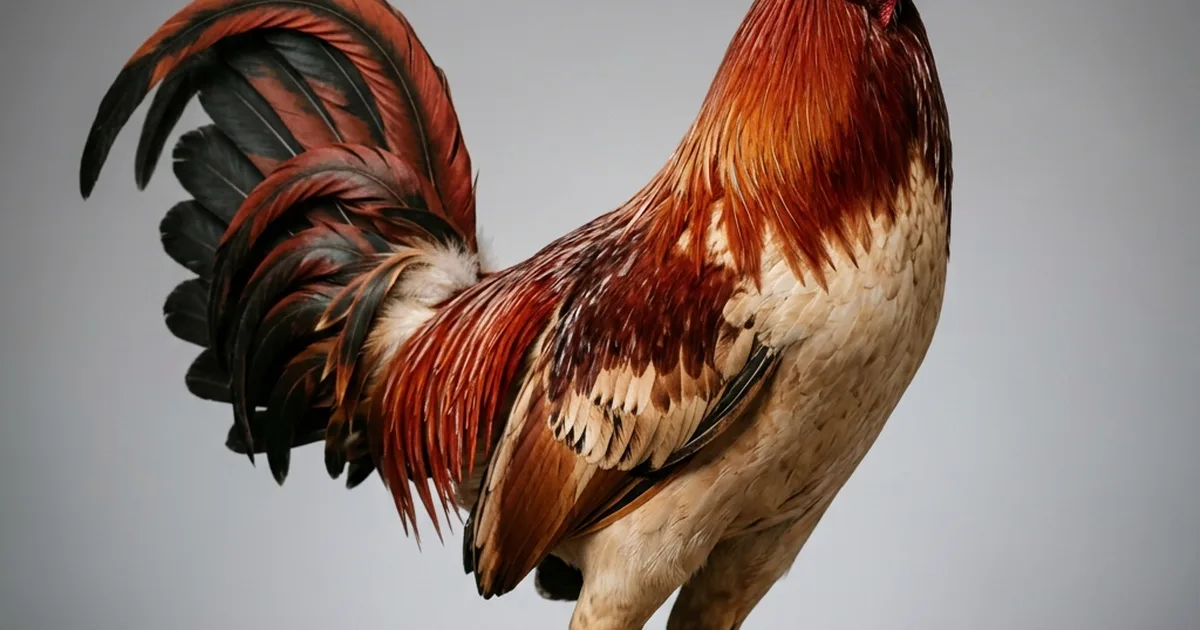
The classical Kelso phenotype is the most refined of the four foundation lines. Build is medium and lean — lighter than Hatch, slightly more refined than Sweater, with a body proportion that reads "built for movement" rather than "built for power." Plumage runs through brown-red, light wheaten, and classic red, with brown-red saddle feathers being a particularly common Kelso marker. Legs are typically yellow, with white-legged variants in some sub-lines. Comb is straight. The overall impression is athletic refinement.
Among Filipino-bred Kelso, the lighter wheaten plumage tends to dominate, and the brown-red Kelso is somewhat less common than the classical Texas type. That divergence is the result of forty years of Filipino selection layered on the imported foundation. As with all the foundation lines, visual identification is unreliable in isolation — pedigree paperwork is the only certain identifier — but among Filipino bloodlines the refined medium frame is the most stable visual cue for Kelso.
The parent breeds guide covers visual identification across all the major Filipino bloodlines and is worth reading alongside this page if you are evaluating a bird in person.
Key Crosses in Philippine Sabong
Kelso is one of the most-crossed foundation lines in Filipino breeding. Because Kelso contributes a stylistic specialism rather than a body-mass contribution, the cross dynamics are different from Hatch's — Kelso adds precision, not frame. The dominant crosses are the ones that win at the major derbies.
Kelso × Sweater. The classic precision-plus-pressure cross, covered from the Sweater side in the Sweater deep-dive. From the Kelso side: the cross adds Sweater's body-punching pressure architecture to Kelso's precision cutting, producing fowl that can both close distance and finish with a clean angled cut once they are in. Heavily used in long-knife circuits and increasingly in slasher derbies where the format rewards both ground presence and angle selection.
Kelso × Hatch. The precision-plus-power cross, covered from the Hatch side in the Hatch deep-dive. From the Kelso side: the Hatch contribution adds frame mass and per-strike force without erasing Kelso's angle-selection habit. The result is a cock that hits harder than a pure Kelso while still cutting cleanly. Used in heavier weight classes where pure Kelso lacks the body mass to compete.
Kelso × Roundhead. The precision-plus-aerial cross. Combines Kelso's distance management and angle selection with Roundhead's aerial work. Produces fowl that can cut from the ground or from above depending on what the opponent forces. The Roundhead deep-dive covers the aerial side.
Kelso × Albany. Less common but documented in specific Filipino kennels. Albany contributes genetic stability for breeding-stock work, which matters when running a long Kelso programme and trying to preserve the cutter trait across generations of crosses.
Across all the crosses, the structural pattern is consistent: Kelso is the precision contributor, and the partner line provides the body mass, the pressure architecture, or the aerial dimension that pure Kelso does not have. The cocker's craft is to balance the two contributions so that the cross retains the cutter's signature without losing the partner line's specialism.
Modern Champions and Derby Placements
Kelso and Kelso crosses have placed at every major Philippine derby for the past two decades. Pure Kelso entries appear at the World Slasher Cup, at the Bakbakan, at the Thunderbird Invitational and at the Visayan Grand Derby; Kelso × Sweater and Kelso × Hatch crosses are even more common in the standings. Specific champion attribution by year requires the official PWBA / event-organiser record, which Sabong88's editorial standard cites by event rather than by inventing kennel names.
The 2026 World Slasher Cup recap documents the specific entries at the XXXVIII (January 2026) and XXXIX (July 2026) editions, including the bloodline crosses of finalist entries. Readers tracking Kelso's competitive record across the 2026 season should treat that recap as the live reference.
Regional pattern: Kelso has historically been particularly strong in Luzon-based long-knife derbies, where the format and the gaff suit the cutter style. The Visayan Grand Derby and other Cebu-region events have also seen consistent Kelso × Sweater placements over the past decade. Kelso's geographic distribution across the Philippines is broader than Sweater's because the cutter style suits a wider range of gaff formats.
Conditioning Notes
Cutter lines like Kelso are conditioned for speed and precision rather than for power or mass. The general programme — multi-week pointing, taper to fight weight, peak on match-day — is the same architecture used across all foundation lines and is documented in the Sabong Conditioning Guide. What changes for Kelso is the emphasis.
Mananaris working a Kelso entry tend to spend more conditioning time on agility and footwork: lateral movement drills, controlled rotation work, the kind of conditioning that supports distance management in the cockpit. Strike-power development matters less; angle development matters more. A Kelso conditioned to hit hard at the cost of speed has been conditioned wrong — the line's signature is the angle, not the force.
The taper window is also calibrated differently. A cutter line that comes into match-day overweight loses its rotation speed; a cutter line that comes in over-conditioned for power loses its precision. The Kelso taper is therefore a balance — enough muscular conditioning to drive the gaff cleanly, not so much that the body mass interferes with the speed. Diet and supplementation match the broader Filipino gamefowl conditioning standard. The principle is to build the cock for what it does in the pit: manage distance, pick angles, finish with one clean cut.
Related Bloodlines
Kelso sits in a family of foundation lines that any sabungero learning the field needs to know in their relation to one another. The Sweater bloodline is the pressure partner — the most-crossed companion to Kelso in Filipino breeding. The Hatch bloodline is the power line — the body-mass counterpoint. The Roundhead bloodline is the aerial line — the air-vs-ground stylistic complement. The parent breeds hub covers Albany, Claret, Lemon, Radio and Texas, the secondary lines that round out the Filipino gallera mix.
For the cultural and regulatory context that frames why these bloodlines matter in the first place, see the history of sabong in the Philippines and the legal guide, which explain how PD 449 governs the licensed cockpit framework that allows traditional sabong to continue.
Frequently Asked Questions
Walter Kelso of Texas is the cocker most consistently credited with stabilising the Kelso line in the 1940s and 1950s. Walter Kelso built the line from a composite base — most published lineage accounts identify Murphy, Madigin, Boston Roundhead and McClanahan strains in the foundation — and ran the line long enough and selected hard enough to make it heritable.
A cutter wins fights with precision rather than with sustained pressure or raw power. The Kelso style emphasises distance management, angle selection on the strike, and clean gaff cuts — typically finishing fights with one or two well-placed strikes rather than with the kind of sustained body work that defines a pressure line. In knife formats, the cutter style is often the most efficient.
Kelso × Sweater and Kelso × Hatch are the dominant Filipino crosses. Kelso × Sweater combines the cutter's precision with Sweater's pressure architecture; Kelso × Hatch combines the cutter's angles with Hatch's per-strike power and frame mass. Both are heavily used in 5-cock and 6-cock derby entries.
Classic Kelso traits include a refined medium build (lighter than Hatch, more refined than Sweater), yellow legs (white in some sub-lines), straight comb, and plumage running through brown-red, light wheaten, and red. The frame is the most reliable visual cue — a Kelso looks built for movement rather than power. Pedigree records remain the only certain identifier.
Kelso is one of the two most popular foundation lines in Philippine sabong, alongside Sweater. The two lines compete for that position depending on the gallera region — Kelso has historically been heavier in some Luzon kennels, while Sweater has been heavier in Pampanga and parts of Negros. In aggregate, Kelso and Sweater together account for the majority of foundation pedigrees in successful Filipino derby entries.
Animal Welfare Disclosure
Sabong88 covers Philippine sabong as a cultural and regulated activity that exists within Philippine law — not as entertainment to be promoted or glamourised. Our editorial position acknowledges the Republic Act No. 8485 (Animal Welfare Act of 1998, as amended by RA 10631) framework that governs animal treatment in the Philippines, while noting that traditional cockfighting in licensed cockpits is specifically permitted under Presidential Decree 449. We do not host fight footage, we do not publish graphic injury imagery, and we do not endorse unlicensed cockfights (tupada) or the recently-suspended online sabong (e-sabong) industry. Our coverage is informational: we explain how the industry works, what the law says, and what readers should know. Readers who oppose cockfighting on welfare grounds will find our reporting on EO9 and the suspension debate useful; readers who follow sabong culturally will find our terminology and breed coverage authoritative. Both audiences deserve accurate information.
Continue exploring: Sweater bloodline | Hatch bloodline | Roundhead bloodline | All breeds (parent hub) | Conditioning Guide | Sabong Derbies | World Slasher Cup 2026