
The Hatch Rooster: Power, Durability & the Bloodline Filipinos Cross with Everything
Why Hatch Matters
Among Filipino breeders the Hatch is sometimes called the universal contributor. Sit through a long pre-derby weighing session in a Pampanga gallera and you will hear the same phrase from different cockers in different family lines: "May Hatch ito" — "this one carries Hatch." The reason is structural. Hatch contributes power and durability without contradicting the specialist trait of the partner line. Cross Hatch into Sweater and you keep the Sweater body-punch but add frame mass. Cross Hatch into Kelso and you keep the Kelso cut but add the staying power that pure Kelso sometimes lacks. Cross Hatch into Roundhead and the aerial work gains a heavier landing weight.
That position — the line everyone crosses with — is the result of a century of selection by American cockers and a half-century of refinement inside Filipino galleras. The line is not the most stylish in the cockpit and it is not the most technically elegant. What it does is hit hard, take hits, and stay composed enough to keep entering. In a 5-cock or 6-cock derby format that is the architectural advantage that decides cumulative scoring.
This guide covers what every sabungero, bettor and breed-curious reader should know about the Hatch line: the Sandy Hatch foundation story, the McLean and Yellow-Legged sub-lines, the puncher fighting profile, the crosses that dominate Filipino derbies, and the conditioning logic that suits a power line. Sabong88 Editorial Team wrote it from inside the Filipino sabong scene; the historical claims trace to American Game Fowl Association archival material and the documented record of the cockers who built the line.
Origin: Sandy Hatch and the McLean Sub-Line
The Hatch line is most consistently attributed to Sandy Hatch, an early-20th-century American cocker whose foundation work created the recognisable Hatch type. Different historical accounts attribute different specific cocks and different specific dams to that foundation, but the published record agrees that Sandy Hatch ran the line long enough and selected hard enough to stabilise the type as a heritable bloodline rather than a one-handler success.
The line then branched. The most commercially significant sub-line is the McLean Hatch, developed by the McLean family of cockers who took Sandy Hatch foundation stock and ran an independent selection programme over multiple decades. McLean Hatch has the classic willow-green leg, the heavier frame, and the dark-red-to-black plumage that most Filipinos picture when they hear "Hatch." A separate sub-line, the Yellow-Legged Hatch, emerged from breeders who selected specifically for yellow-legged offspring while preserving the Hatch power profile — useful when matching against yellow-legged dams in cross-breeding programmes.
By the time Hatch reached the Philippines in the 1970s and early 1980s, the line had already branched into McLean, Yellow-Legged, and several smaller variants. Filipino importers brought trios from multiple sub-lines, and the Filipino-bred Hatch that fights at the World Slasher Cup today is a composite of those imports plus the selection pressure of forty years of Philippine derby competition. As with Sweater, the modern Filipino Hatch is recognisably its own line — related to the Texas original but shaped by tropical climate, knife-format derbies, and Filipino conditioning protocols.
Anyone serious about Hatch foundation stock should treat the sub-line distinction as load-bearing. A McLean Hatch and a Yellow-Legged Hatch are not interchangeable in a breeding programme; they bring different leg colour, slightly different plumage, and slightly different daughters. The breeder's stud-book — not the colloquial label — is the document that matters.
Fighting Style: Power, Durability, Composure Under Hits
The defining trait of a Hatch in the cockpit is power. Per individual gaff strike, a well-conditioned Hatch hits harder than its sibling lines. The line tends to commit weight forward in the strike, drives the gaff with a heavier frame behind it, and finishes with the kind of decisive cut that ends short fights inside the first two or three exchanges. In knife-format matches with sharp gaffs, that single-strike capability is the line's signature advantage.
The second defining trait is durability. Hatch fowl absorb hits and remain composed. They do not panic when struck; they reset their stance, re-engage, and continue the fight. That composure under fire is what makes the line survive deep into long matches even when the early exchanges have not gone its way. In the working vocabulary of Filipino mananaris, a Hatch is the cock you trust not to break.
The trade-off is speed. Hatch fowl are heavier than Sweater or Kelso and noticeably slower across the cockpit floor. Against a fast cutter who refuses to engage in close combat, a Hatch can spend the early exchanges chasing rather than landing, expending energy on a target that keeps rotating away. That is the structural reason Filipino breeders rarely run pure Hatch entries in 6-cock derbies — the format rewards consistency across many matches, and pure Hatch sometimes loses to Kelso or Roundhead specialists who exploit the speed differential.
Compared to its sibling lines, the contrast is sharp. The Sweater works the body with sustained pressure rather than single power strikes. The Kelso wins with precision and angled cutting rather than raw force. The Roundhead uses the air rather than ground power. Hatch is the only one of the four foundation lines where the dominant signature is the strike itself rather than the movement around it.
The format implication: Hatch is strongest in short knife formats and in any fight that can be ended by one decisive cut. Hatch is weakest in long slasher work where speed and pressure-management matter more than per-strike power. Filipino breeders address that weakness by crossing — which is why the Hatch contribution is everywhere in successful Filipino derby entries even though pure Hatch entries are rarer at the top tier than pure Sweater or pure Kelso.
Physical Identification
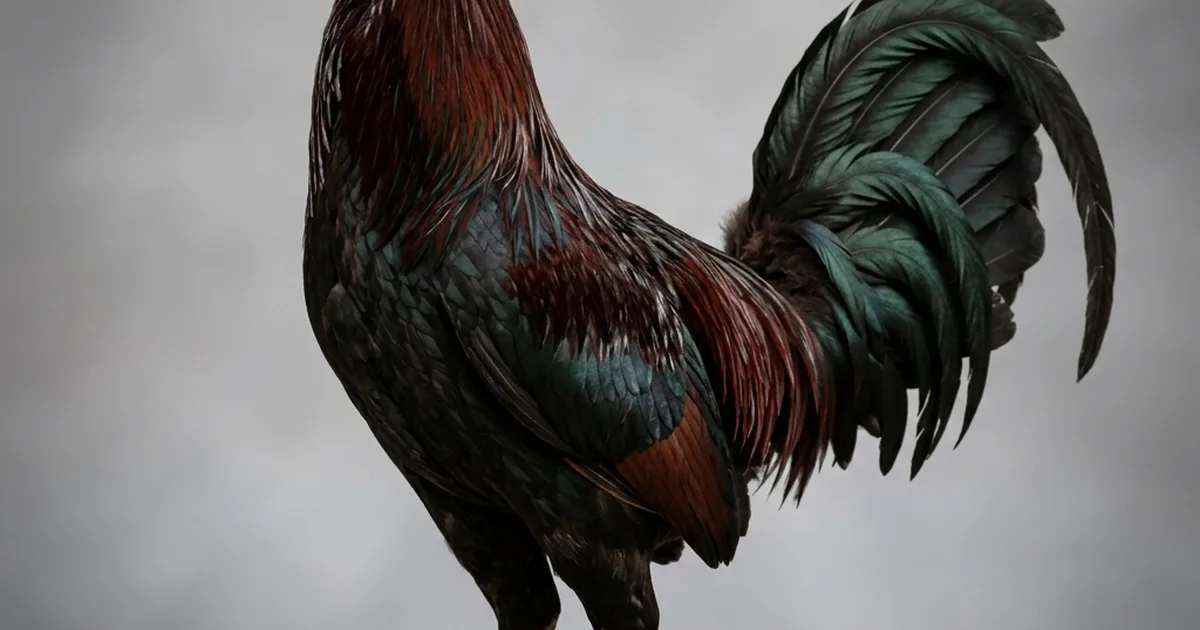
The classic McLean Hatch phenotype is recognisable. Plumage runs dark red to almost black-red, with glossy hackle feathers that show a deeper red than Sweater's mahogany. Legs are willow-green, the trait most often used for visual ID at a distance. The frame is the giveaway: a Hatch carries more body mass than Sweater or Kelso, with a heavier breast, a broader keel, and a more substantial leg structure. Comb is straight. The Yellow-Legged Hatch sub-line breaks the leg-colour rule but preserves the heavier frame.
That said, visual identification is unreliable for the same reason it is unreliable across all the foundation lines: Filipino breeders cross Hatch into nearly everything. A cock that visually presents as Hatch may be a Hatch × Sweater that has thrown to the Hatch parent. A cock that looks lighter than expected may still carry significant Hatch behind it. The frame mass is the most stable visual cue, but the only certain identifier remains pedigree paperwork.
The parent breeds guide covers visual identification across all the major Filipino bloodlines and is worth reading alongside this page if you are evaluating a bird in person.
Key Crosses in Philippine Sabong
Because Hatch contributes a stylistic addition rather than a stylistic replacement, the line crosses with everything. The dominant Filipino crosses are the ones that win at the major derbies and that have a name on the gallera circuit.
Hatch × Sweater (Swatch). The most common cross in Filipino sabong, covered from the Sweater side in the Sweater deep-dive. From the Hatch side: this cross is the line's most successful contribution to Filipino derby competition. Adds Hatch's frame and durability to Sweater's pressure architecture, producing fowl that stay competitive across the long matches that decide 5-cock and 6-cock derbies.
Hatch × Kelso. Combines Kelso's precision cutting with Hatch's frame and per-strike power. Produces fowl that can finish fights with one clean angled cut backed by Hatch's body weight. Heavily used in long-knife circuits where a single decisive gaff strike ends matches. The Kelso deep-dive covers the cutter side of this cross.
Hatch × Roundhead. Adds Hatch durability to the aerial Roundhead profile. The Roundhead contributes timing and the willingness to jump and cut from above; Hatch contributes the staying power that pure Roundhead sometimes lacks. Among slasher-format entries this cross has produced consistent placements at the World Slasher Cup. The Roundhead deep-dive covers the aerial side.
Hatch × Texas. A heavier-framed cross used by specific Filipino breeders who want maximum body mass in the cock. Texas is itself a big-framed line and the cross produces fowl noticeably heavier than the Filipino average — useful in heavier weight classes but slower across the floor.
Hatch × Albany / Hatch × Claret. Less frequent crosses, used to address specific breeding goals — Albany contributes genetic stability for breeding-stock work and Claret contributes endurance and gameness. Each is documented in specific Filipino kennels rather than being a circuit-wide pattern.
Across all of these, the structural pattern repeats: Hatch is the contributing line rather than the architectural base. The partner line provides the dominant style; Hatch provides the frame and the durability that lets that style persist deep into long matches.
Modern Champions and Derby Placements
Hatch crosses appear in the top tier of every major Philippine derby. Pure Hatch entries are less common than Hatch crosses, but the contribution of Hatch behind the cross is documented in entry records at the World Slasher Cup, the Bakbakan, the Thunderbird Invitational and the Visayan Grand Derby. Specific champion attribution by year requires the official PWBA / event-organiser record, and Sabong88's editorial standard is to cite that record by event rather than to invent kennel names.
The 2026 World Slasher Cup recap documents the specific 2026 entries at the XXXVIII (January) and XXXIX (July) editions, including the bloodline crosses of finalist entries. Readers tracking Hatch's competitive record across the 2026 season should treat that recap as the live reference.
At the regional level, Hatch crosses are particularly visible in Pampanga, Bulacan and Negros derbies — the regions with the longest history of Hatch foundation stock and the most stable Hatch breeding programmes. The Visayan Grand Derby has consistently shown Hatch-cross entries in the top 10 standings for the past decade.
Conditioning Notes
Power lines like Hatch are conditioned differently from speed lines. The general programme — multi-week pointing, taper to fight weight, peak-on-match-day — is the same architecture used across all foundation lines and is documented in the Sabong Conditioning Guide. What changes for Hatch is the emphasis.
Mananaris working a Hatch entry tend to spend more conditioning time on strike-power development — controlled sparring focused on driving the gaff with the full body behind it, breast and shoulder development that supports the heavier per-strike output, and the kind of muscular conditioning that suits a power-puncher rather than a runner. Aerial work is less central; ground work and frame conditioning matter more.
The taper window is also different. A power line that comes into match-day overweight loses its strike speed; a power line that comes in underweight loses the per-strike force that is its signature. The Hatch taper is therefore tighter than the Sweater taper — less margin for error in the final 72 hours, more careful weight management in the final week. Diet and supplementation match the broader Filipino gamefowl conditioning standard. The principle is to build the cock for what it actually does in the pit: hit hard, take hits, stay composed.
Related Bloodlines
Hatch sits in a family of foundation lines that any sabungero learning the field needs to know in their relation to one another. The Sweater bloodline is the pressure partner — the most-crossed companion to Hatch in Filipino breeding. The Kelso bloodline is the cutter — the precision counterpoint. The Roundhead bloodline is the aerial line — the air-vs-ground stylistic complement. The parent breeds hub covers Albany, Claret, Lemon, Radio and Texas, the secondary lines that round out the Filipino gallera mix.
For the cultural and regulatory context that frames why these bloodlines matter in the first place, see the history of sabong in the Philippines and the legal guide, which explain how PD 449 governs the licensed cockpit framework that allows traditional sabong to continue.
Frequently Asked Questions
The line is widely attributed to Sandy Hatch in the early 20th century, with the McLean Hatch sub-line developed by McLean and the Yellow-Legged Hatch variant emerging from later breeders selecting for the yellow-legged trait. By the time Hatch reached the Philippines in the 1970s and 1980s the line had branched into several recognised sub-families.
McLean Hatch is the older sub-line, typically showing the classic willow-green leg and dark plumage. Yellow-Legged Hatch is a later refinement selecting for yellow-legged offspring while preserving the Hatch power profile. Filipino breeders use both, often for different cross objectives — McLean for foundation power, Yellow-Legged when matching against yellow-legged dams.
Hatch contributes power, durability and the ability to absorb hits without breaking composure. Crossed into Sweater, Kelso or Roundhead, the Hatch input typically improves the cross's frame strength and stamina without erasing the partner line's specialist traits. That is why Hatch is the universal contributor in Filipino breeding programmes.
Classic Hatch traits are heavier build, broad chest, and willow-green legs (with yellow legs in the Yellow-Legged sub-line). Plumage tends to dark red or black-tinged red. The frame is the most reliable visual cue — Hatch fowl carry more body mass than Sweater or Kelso. Pedigree records remain the only certain identifier.
Pure Hatch versus pure Sweater is a power-vs-pressure mismatch. Hatch hits harder per strike; Sweater sustains more pressure across more strikes. In short fights settled by one decisive cut, Hatch often wins. In long fights and 6-cock derbies where the entry must perform across multiple matches, Sweater fowl tend to outlast pure Hatch entries — which is why Filipino breeders so often cross the two.
Animal Welfare Disclosure
Sabong88 covers Philippine sabong as a cultural and regulated activity that exists within Philippine law — not as entertainment to be promoted or glamourised. Our editorial position acknowledges the Republic Act No. 8485 (Animal Welfare Act of 1998, as amended by RA 10631) framework that governs animal treatment in the Philippines, while noting that traditional cockfighting in licensed cockpits is specifically permitted under Presidential Decree 449. We do not host fight footage, we do not publish graphic injury imagery, and we do not endorse unlicensed cockfights (tupada) or the recently-suspended online sabong (e-sabong) industry. Our coverage is informational: we explain how the industry works, what the law says, and what readers should know. Readers who oppose cockfighting on welfare grounds will find our reporting on EO9 and the suspension debate useful; readers who follow sabong culturally will find our terminology and breed coverage authoritative. Both audiences deserve accurate information.
Continue exploring: Sweater bloodline | Kelso bloodline | Roundhead bloodline | All breeds (parent hub) | Conditioning Guide | Sabong Derbies | World Slasher Cup 2026